Click & Collect, Delivery, or Pickup: Which Channel Should Your Restaurant Choose in 2026?
Click and collect, delivery, or takeout: a complete comparison of costs, margins, and strategy to pick the right channel for your restaurant in 2026.
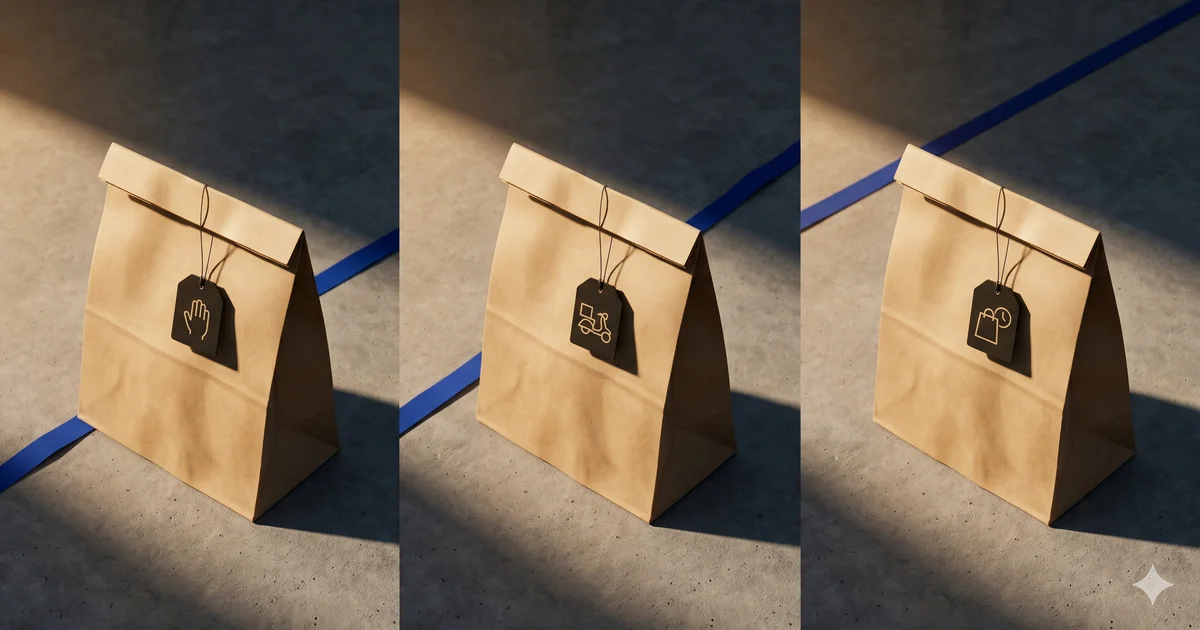
In 2026, opening a restaurant is no longer enough: you have to decide which channels your customers will order through. Click and collect has exploded since 2020, delivery has gone mainstream but eats into your margins, and good old-fashioned counter takeout remains the most profitable option at the register. So which channel should you pick, or should you combine them all? This guide compares the three most-used restaurant sales channels in detail, with their average tickets, hidden costs, and growth potential. The goal: help you make the right call based on your concept, your trade area, and your resources.
Click & Collect: the channel that is exploding in 2026
Click and collect, sometimes called “online order with in-store pickup,” lets customers order and pay from their phone, then come grab their bag at a specific time slot. The format has gone mainstream: according to data shared by foodservice research firms such as Circana (formerly NPD Group), a majority of U.S. consumers have used this channel at least once in the past year, growing fast since 2020. For the operator, it is a friction-free channel on the economics side, with no platform commission and no delivery cost.
The numbers speak for themselves. The average click and collect ticket ranges from $24 to $42 depending on the concept, versus $15 to $22 for counter takeout. Why the gap? Because customers take their time, see the full menu, and have nobody behind them in line. Sides, drinks, and desserts get added to the cart more easily. The conversion rate on a well-designed product page lands around 8 to 14 percent, based on data shared by ordering platform vendors.
The benefits of click and collect do not stop there. You smooth out production: orders arrive spaced across time, with a known pickup slot. You capture customer data: email, history, frequency, which makes a real loyalty strategy possible. And you work without intermediaries, so no commission cuts into your margin. As of today, it is the most profitable digital channel for an independent restaurant or a small chain.
Delivery: with or without an in-house fleet?
Restaurant delivery has become a standard, but it is also the toughest channel to navigate. Three options are available: build your own delivery fleet, hand it off to third-party delivery platforms, or combine both in a hybrid model. Each choice has direct consequences on your net margin.
With an in-house fleet, you stay in control: you set the delivery zone, the price, the cadence. The cost of an employed or contract driver runs between $18 and $26 per hour, fully loaded. On an average $35 ticket, this stays viable if you can chain two to three deliveries per hour. Below that, you lose money. That is why in-house fleets work best in dense, urban areas, with a menu engineered to drive a high average ticket.
Delivery aggregators bring volume and visibility, but at a cost. The commissions charged by third-party delivery platforms swing between 25 and 35 percent of the ticket, sometimes more with featured-placement add-ons. According to recurring analyses from foodservice research firms such as Datassential, a restaurant that gets more than 40 percent of its revenue through these platforms sees its overall net margin drop by 4 to 7 points. The best practice today: use those channels for acquisition, then pull customers back to your direct channels. To dig deeper into this equation, read our dedicated analysis of third-party delivery platforms.
Launch your click and collect in 48 hours
Custom ordering page, integrated payment, kitchen notifications. No commission, no lock-in.
Counter takeout: the underrated option
In all the noise around digital, traditional counter takeout often gets pushed to the back burner. That is a strategic mistake. This restaurant ordering channel remains, in absolute terms, one of the most profitable: no commission, no logistics, and immediate cash collection. According to 2024 industry research, takeout still represents around 30 percent of quick-service revenue in the U.S.
The customer profile is different from click and collect. It is often a busy professional, a passing pedestrian, or a neighborhood regular. The average ticket is lower, around $15 to $22, but volume more than makes up for it. And above all, acquisition cost is zero: the person is already in front of your window. Your real lever is the counter experience: fast checkout, a readable menu, and well-placed upsells.
The trap is treating it as a channel separate from digital. In 2026, the boundary is fading: a customer can order online while walking toward the restaurant, or reserve their place in line via a kiosk. Folding counter takeout into your digital strategy means combining the best of both worlds: the spontaneity of the counter and the data richness of click and collect.
Detailed comparison: cost, margin, customer effort, scalability
To choose between the three channels, here is a synthetic view of the key indicators. The ranges come from industry studies and feedback from independent operators in the U.S. and Canada.
| Criteria | Click & Collect | Delivery | Counter Takeout |
|---|---|---|---|
| Average ticket | $24 to $42 | $30 to $50 | $15 to $22 |
| Net margin | 65 to 75% | 35 to 55% | 70 to 80% |
| Operational complexity | Low to medium | High | Low |
| Scalability | Very high | High but costly | Capped by foot traffic |
| Acquisition cost | Medium (local marketing) | High (commissions, ads) | Near zero (walk-in) |
Quick read: click and collect is the best margin-to-scalability trade-off. Delivery generates volume but sacrifices 20 to 30 margin points. Counter takeout keeps the best unit profitability but is capped by the natural flow in front of your door. No channel is universally better: it all depends on your location, your menu, and your growth goals.
Why a hybrid strategy always wins
The “click and collect or delivery” question is actually the wrong one. The operators who win in 2026 do not choose: they orchestrate. The idea is to let customers self-select the channel that fits them, while optimizing the economics of each channel individually.
In practice, it looks like this. At lunch, you push click and collect to the offices within a quarter-mile: high ticket, fast pickup, zero commission. In the evening, you activate delivery via your in-house fleet within a 2-mile radius, and you let third-party delivery platforms cover the farther zones where your own logistics would not be profitable. Meanwhile, counter takeout runs continuously for walk-ins. Each channel feeds the others: a delivery customer who enjoys the experience can switch to click and collect the following month, saving you 30 percent in commission.
This multi-channel strategy demands a tool capable of centralizing everything, otherwise your kitchen turns into a cacophony of paper tickets and beeping tablets. That is exactly the role of our solution: unify orders, no matter their origin, into a coherent production flow. Operators no longer waste time juggling interfaces, and the kitchen team sees a single queue, prioritized by pickup or delivery time.
How to run it all from a single interface
The operational challenge is centralization. Stacking channels without a unified tool means stacking sources of error: missed orders, double prep, late pickups. XPRIO was built to solve exactly this problem: every order, whether it comes from your built-in click & collect, your delivery site, or the counter register, lands on the same kitchen screen.
On the analytics side, you get a dashboard per channel: average ticket, conversion rate, real margin after commissions. You see in real time which channel is performing and where to reallocate marketing spend. Menu sync is automatic: an out-of-stock item propagates instantly across all channels, which prevents the awkward cancellation of an order a customer has already paid for.
On pricing, the XPRIO approach is based on a fixed monthly subscription with no commission on the revenue generated by your direct channels. You keep 100 percent of the margin on your click and collect and counter takeout, and you only pay commissions on flows coming from third-party marketplaces. Plan details are on the pricing page, with simple math: starting at about ten click and collect orders per day, the tool pays for itself in commissions avoided.
Centralize your three channels in one interface
Click and collect, delivery, pickup: one kitchen screen, one dashboard, zero commission on your direct channels.
Start my free trialConclusion: the key takeaways
- Click and collect remains, in 2026, the most profitable digital channel for an independent restaurant: high average ticket, zero commission, customer data captured.
- Delivery is unavoidable but must be managed as an acquisition channel, not as a margin source.
- Counter takeout keeps the best unit margin and should never be neglected in favor of digital alone.
- The winning strategy is not to pick a channel, but to orchestrate them smartly across day parts and your customer geography.
Choosing an ordering channel is no longer a binary decision in 2026. It is a constant trade-off between margin, volume, and customer experience. The operators who come out ahead are the ones who measure each channel separately, adjust their mix month after month, and equip themselves with tools that absorb this complexity without passing it to the kitchen team. If you are still on the fence about where to start, begin with click and collect: it has the best effort-to-margin ratio, and it is the technical foundation on which you can later layer delivery and counter takeout without starting over.
Frequently asked questions
What is the difference between click and collect and traditional takeout?
Click and collect means ordering and paying online, then picking up at a chosen time slot. Traditional takeout is ordered at the counter, with no digital reservation.
Is click and collect profitable for a small restaurant?
Yes. With near-zero commission and an average ticket typically 15 to 25 percent higher than the counter, it improves net margin from the very first weekly orders.
Should you offer delivery via an in-house fleet or a third-party platform?
An in-house fleet protects your margin within a 2-mile radius. Beyond that, third-party delivery platforms remain more profitable despite 25 to 35 percent commissions, thanks to the volume they generate.
What is the average click and collect ticket in 2026?
Industry studies put the average click and collect ticket between $24 and $42 in commercial foodservice, versus $15 to $22 for counter takeout.
Can you combine click and collect, delivery, and pickup without overloading the kitchen?
Yes, as long as orders are centralized in a single production screen. A unified interface prevents duplicates, missed tickets, and rush-hour stress.
Get hands-on with XPRIO
Mobile app, website, order management: all live in 72h. No commitment.
Start my free trialRelated articles
How Much Do Delivery Platforms Really Cost a Restaurant Owner in 2026?
Delivery platform commission, hidden fees, margin impact: a full breakdown of the real costs and viable alternatives in 2026.
Take Back Control: The Practical Playbook to Gradually Leave Third-Party Delivery Platforms
Leave delivery platforms with no risk: a 6-month switch plan, concrete weekly steps, and measured margin recovered for restaurant operators.
Managing Your Delivery Drivers Without Paying 30% Commission: In-House Fleet or Third-Party Platform in 2026?
Restaurant delivery fleet in-house or third-party platform in 2026: real cost, tipping point, hybrid model and tools to operate without paying 30% commission.