Managing Your Delivery Drivers Without Paying 30% Commission: In-House Fleet or Third-Party Platform in 2026?
Restaurant delivery fleet in-house or third-party platform in 2026: real cost, tipping point, hybrid model and tools to operate without paying 30% commission.
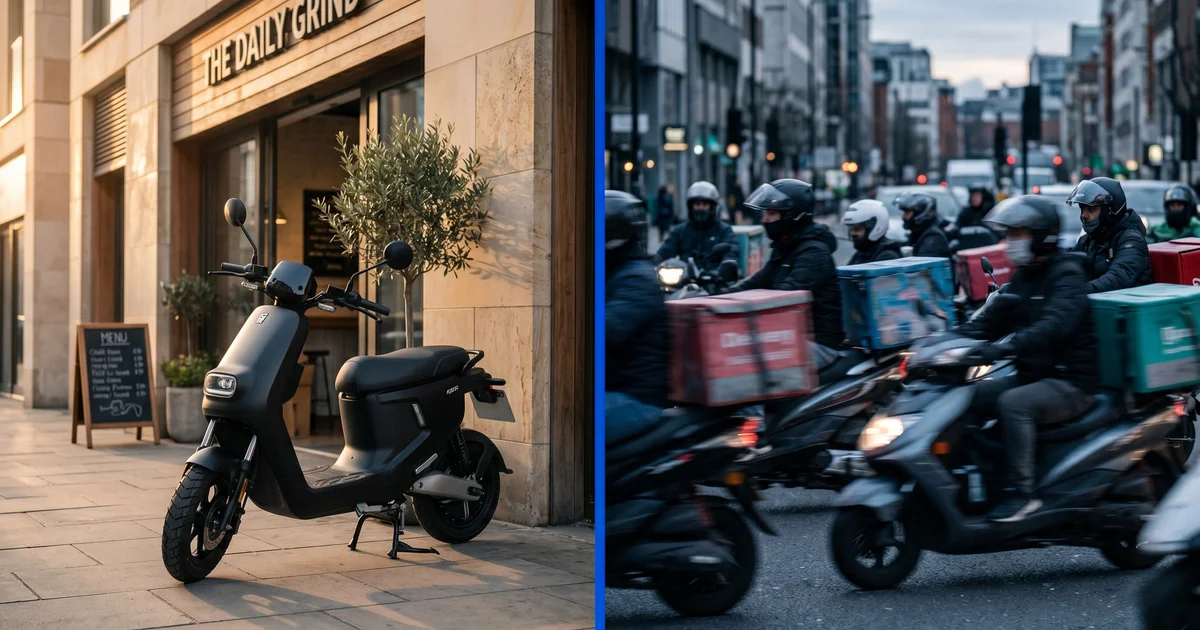
You bill $30,000 per month in delivery and you hand 25 to 35% of that to a third-party platform. Do the math: that’s between $7,500 and $10,500 walking out the door every month, the equivalent of two fully loaded full-time salaries. The question of an in-house restaurant delivery fleet is no longer a philosophical debate: it’s an accounting equation. In 2026, more and more restaurant operators are switching to their own logistics, sometimes a mixed setup. But at what volume does it become profitable? What are the real hidden costs? And above all, how do you run a fleet without turning service into telephone chaos? This guide gives you the decision framework.
The platform model: what you really pay in 2026
The advertised commission is only part of the cost. In the United States, third-party platforms take between 25 and 35% of the order total, depending on your package (delivery included or not, boosted visibility, premium program). On top of that come the marketing fees you pay to appear at the top of the list, co-funded promotions (the famous “buy one, get one free” that partly comes out of your pocket), and sometimes fixed monthly fees or onboarding costs.
On an average ticket of $30, the gross commission sits between $7.50 and $10.50. If you add $1 to $2 of promotion campaigns to stay visible and $1 to $2 of co-funded promos, you land at a real acquisition cost between $9 and $14 per order. In other words, nearly 40% of the ticket can disappear before you’ve even paid for ingredients and packaging. To understand the full mechanics and the negotiation levers, we covered this topic in depth in our dedicated article on third-party delivery platforms.
The second problem, more strategic, is the loss of the customer relationship. You don’t get the guest’s phone number, you don’t get their order history, you don’t get the ability to follow up with a push notification. You’re paying 30% to rent an audience you don’t own.
The in-house fleet model: how it actually works
Building a delivery fleet doesn’t necessarily mean hiring ten people. Three configurations coexist on the ground. The first: salaried drivers on full or part-time employment, present on fixed shifts (lunch 11:30am-2:30pm, dinner 6:30pm-10:30pm). It’s the safest option for availability, with a loaded cost between $15 and $25 per hour depending on the local market and labor regulations. The second: independent couriers paid per run, generally between $5 and $9 per delivery in urban zones. The third: contracting with external courier services that bill per job, with no HR commitment.
The total cost doesn’t stop at wages. You have to factor in vehicle depreciation (a 50cc scooter runs around $2,000 to $3,000, an electric cargo bike between $2,000 and $4,000), commercial insurance, equipment (insulated bag, helmet, branded apparel), fuel or charging, and maintenance. Expect on average $150 to $250 per month per vehicle in additional expenses.
There’s one line item that often gets forgotten: the cost of restaurant delivery dispatch. Without a tool, the manager spends the entire service calling drivers on text messages, shouting addresses from the kitchen, losing paper tickets. This coordination time is a very real hidden cost.
Run your drivers from a single app
XPRIO natively includes an iOS and Android driver app with automatic dispatch, built-in navigation and real-time GPS tracking.
Detailed comparison: cost per order, in-house fleet vs platform
Let’s take the example of an average ticket of $30 and compare the two models line by line.
| Cost item ($30 ticket) | In-house fleet | Third-party platform |
|---|---|---|
| Commission or driver cost | $5.00 to $7.50 (salaried driver $20/hr, 3 runs/hr) | $7.50 to $10.50 (25 to 35%) |
| Marketing / promoted placement | $0 to $0.50 (your own push) | $1.00 to $2.00 |
| Co-funded promotions | $0 to $0.50 (optional) | $1.00 to $2.00 |
| Cost of goods (28%) | $8.40 | $8.40 |
| Packaging and consumables | $0.80 | $0.80 |
| Payment processing (Stripe 2.9% + $0.30) | $1.17 | $0 (included in commission) |
| Remaining gross margin | $12.13 to $14.13 | $6.30 to $9.30 |
The gap is clear: on the same ticket, your in-house fleet preserves between $4.80 and $7.80 of additional margin. Multiplied by 1,000 monthly orders, that represents $4,800 to $7,800 of additional cash every month, which is exactly what pays your drivers’ wages.
The tipping point: at what volume does the fleet become profitable?
The central question of restaurant driver cost is simple: at what cadence does your driver cost less than a third-party platform?
Take a salaried driver at $20 per hour loaded. If they make a single delivery per hour, the cost per run is $20, or 67% of a $30 ticket. Obviously, that’s ruinous. At two deliveries per hour, the cost drops to $10 per run, or 33% of the ticket, already competitive with a platform. At three deliveries per hour, you fall to $6.67, or 22% of the ticket. At that pace, you save 8 to 18 margin points per order.
The rule of thumb: your in-house fleet becomes economically viable above 2 deliveries per driver per hour during open shifts. In practice, that corresponds to roughly 25 to 35 orders delivered per day for a single driver working lunch and dinner services. Below that, you’re working at a loss or at parity with the platform, and you’re better off either skipping the fleet altogether or combining it with a platform to smooth the load.
Another tipping signal: the average ticket. The higher it is (above $35), the more profitable the in-house fleet becomes because your driver cost stays fixed while the platform commission grows proportionally.
The hybrid model: in-house fleet for the dense zone + platforms beyond
The trap would be to think in all-or-nothing terms. The most effective strategy observed on the ground in 2026 is hybrid: your in-house fleet covers the dense radius, third-party platforms absorb the long tail.
Concretely, your salaried drivers or dedicated couriers handle every order within a 0 to 2 mile radius. In this zone, run time is short (10 to 15 minutes round trip), the cadence easily exceeds 2-3 deliveries per hour, and the average ticket is generally higher because these are your repeat customers ordering directly on your site and your app. Orders 2 to 5 miles out, rarer and more expensive to deliver in-house, go to the third-party platforms. You sacrifice margin on those peripheral orders to preserve volume.
This approach has another strategic advantage: it makes you less dependent. To go deeper on the method, see our article on how to reduce your dependency on platforms. The target ratio in a well-established urban zone hovers around 70% in-house fleet / 30% third-party platforms on delivery revenue.
The technical tools to run an in-house fleet
Without a dedicated tool, managing three drivers is already an operational nightmare: printed tickets lost, messaging calls in the kitchen, drivers crossing paths, customers calling back to find out where their order is. At five simultaneous drivers, it’s unmanageable.
A real restaurant driver app centralizes four essential functions. First, automatic dispatch: the order ready in the kitchen is assigned to the nearest available driver, with no manual intervention. Second, built-in navigation to Google Maps, Waze or Apple Maps depending on the driver’s preference. Third, code-based delivery confirmation, which secures the handoff and automatically triggers the “delivered” status. Fourth, real-time driver status updates (“accepted”, “en route to restaurant”, “picked up”, “en route to customer”, “arrived”, “delivered”) with a push notification to the customer at every step.
That’s exactly what XPRIO provides in its solution bundle: ordering site, iOS and Android apps for your customers, and a native iOS and Android driver app for your couriers, all integrated and included in the same subscription. On the manager side, a delivery GPS tracking map displays each driver in real time, their orders in progress, their average time per run. You see at a glance who’s stretched thin, who can take an extra order, and you can reassign manually if needed. No phone calls, no paper tickets. Full details of the offer are available on our pricing page.
To benchmark your HR costs related to salaried drivers, you can consult the wage data and employment statistics for the food service industry published by the U.S. Bureau of Labor Statistics.
Take back control of your deliveries
Site, iOS/Android customer apps, driver app and real-time dispatch: everything is included in a single XPRIO subscription.
Start my free trialConclusion: the key takeaways
- Platform commission hides additional fees: marketing, co-funded promos, loss of the customer relationship. The real cost often reaches 35 to 45% of the ticket.
- An in-house fleet becomes profitable above 2 deliveries per driver per hour, or roughly 25 to 35 runs per day per driver.
- The margin gap per order is $4 to $8 in favor of the in-house fleet on a $30 ticket, representing several thousand dollars per month at moderate volumes.
- The hybrid model is the most robust: in-house fleet within 0-2 miles to preserve margin, third-party platforms as a complement on the peripheral zone.
- Without a technical tool, the in-house fleet collapses operationally: you need a driver app with dispatch, navigation, GPS tracking and real-time status updates.
Independent restaurant delivery isn’t reduced to hiring a driver. It’s a system that combines human resources, equipment and operating software. Properly sized, your fleet turns a commission expense into a productive investment. Poorly run, it adds chaos to a kitchen already under pressure. The difference between the two comes down to the quality of dispatch and your ability to measure the real cadence of each driver, week after week.
Frequently asked questions
At what point does an in-house fleet become profitable, in deliveries per hour?
Generally, above 2 deliveries per hour per driver, the implicit cost drops below 18% of the ticket, which falls under the average commission charged by a third-party platform.
Should you put your drivers on payroll or use independent couriers?
Payroll secures availability during peak hours. Independent couriers offer flexibility but often cost $5 to $9 per delivery in urban areas.
What is the ideal delivery radius for an in-house fleet?
Between 0 and 2 miles by scooter or electric cargo bike. Beyond that, round-trip time explodes and the cost per delivery exceeds that of a third-party platform.
What app should you use to manage your drivers in real time?
A native iOS and Android restaurant driver app with automatic dispatch, GPS tracking and code-based delivery confirmation, integrated with your ordering site.
Can you combine an in-house fleet with third-party platforms?
Yes, this is the recommended hybrid model: in-house fleet within the dense radius to preserve margin, third-party platforms as a complement to absorb peripheral orders.
Get hands-on with XPRIO
Mobile app, website, order management: all live in 72h. No commitment.
Start my free trialRelated articles
Click & Collect, Delivery, or Pickup: Which Channel Should Your Restaurant Choose in 2026?
Click and collect, delivery, or takeout: a complete comparison of costs, margins, and strategy to pick the right channel for your restaurant in 2026.
How Much Do Delivery Platforms Really Cost a Restaurant Owner in 2026?
Delivery platform commission, hidden fees, margin impact: a full breakdown of the real costs and viable alternatives in 2026.
Take Back Control: The Practical Playbook to Gradually Leave Third-Party Delivery Platforms
Leave delivery platforms with no risk: a 6-month switch plan, concrete weekly steps, and measured margin recovered for restaurant operators.