Restaurant Mobile App vs Website: Which Should You Choose in 2026?
Restaurant mobile app and website: why both channels complement each other and how to launch them together to maximize your results in 2026.
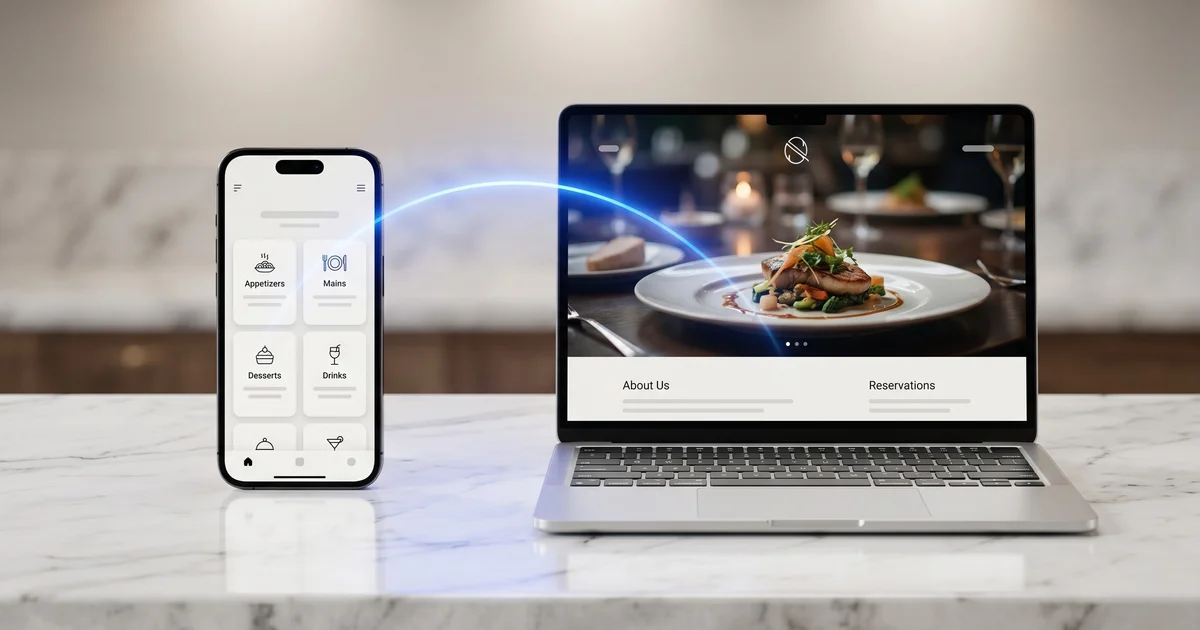
Picture two neighboring restaurants, same neighborhood, same average ticket. The first invested $15,000 in a restaurant mobile app but has no website. The second has a flawless responsive site but no app. Six months later, both have missed something. They isolated a channel that was meant to work as a team with the other. In 2026, the real question is no longer “mobile app or website for my restaurant?”, it is “how do I launch them together so they reinforce each other from day one?”. This guide gives you the keys to understanding how the two channels complement each other and how to avoid the trap of the binary choice.
Restaurant website: the unavoidable digital entry point
Let us start with a simple fact: all your customers will visit your website at some point in their journey. The tourist discovering your neighborhood, the neighbor hesitating between two addresses, the journalist preparing an article, the company looking for a caterer for an event. None of them will download an app just to take a quick look. And that is precisely why a restaurant website remains, in 2026, your mandatory digital storefront.
The website plays three fundamental roles. First, it welcomes without friction: no download, no account to create just to browse the menu, just a link to click. Second, it reassures during the discovery phase with food photos, a detailed menu, hours, address, and reviews. Third, it converts immediately: a click and collect order, a table reservation, a delivery cart, with no app and no middleman in the way.
It is also the most shareable channel. When a customer sends your restaurant link to a friend on WhatsApp, or when you publish a post with a call to action on Instagram, it is your website that loads. An app cannot do this: you do not share an app store listing, you do not check it in two seconds on a bus ride. That is exactly why our solution includes a custom responsive website for every restaurant, delivered simultaneously with the mobile app.
Restaurant mobile app: the loyalty channel by excellence
Now let us look at the other channel. The restaurant mobile app suffers from an obvious structural handicap: you have to convince a customer to download something. It is a cognitive effort and a storage cost that many will refuse. The average install rate of an independent restaurant app sits, based on several 2024-2025 industry analyses, between 3 and 8 percent of website visitors.
But once installed, the app becomes a formidable loyalty machine. Here is why. First, your logo occupies a permanent spot on your customer’s home screen: it is the equivalent of a free billboard in their pocket. Next, you gain access to push notifications, the marketing channel with the highest open rate on the market (between 20 and 40 percent versus 2 to 4 percent for email). Finally, the ordering experience is radically smoother: saved payment methods, history, favorites, integrated loyalty program.
The measurable result: users of a restaurant app order on average 2 to 3 times more often than those who go through the website only, according to industry studies compiled by research firms such as Statista. This frequency gap is what justifies the investment, provided the app comes as a complement to a working website, not as a replacement.
Website and app: why choose?
XPRIO delivers a responsive website plus an iOS and Android mobile app under your brand, all managed from a single dashboard, launched together.
Honest comparison: 6 criteria that actually matter
Here is a clear-eyed comparison, with no spin, on the six criteria that genuinely weigh on the decision.
| Criterion | Restaurant website | Restaurant mobile app |
|---|---|---|
| Initial acquisition cost | Low ($1,200 to $6,000) | High ($10,000 to $50,000 custom) |
| Visitor to order conversion rate | Medium (2 to 5 percent) | High (15 to 30 percent after install) |
| Purchase frequency per customer | Baseline (x1) | Multiplier of 2 to 3 |
| Long-term retention | Low (little direct return) | Strong (permanent icon, push, loyalty) |
| Accessibility without install | Total (direct link) | None (download required) |
| Push notifications | Limited (web push opt-in) | Native, open rate 20 to 40 percent |
Read this table carefully. No row declares an absolute winner. The restaurant website wins on entry cost, frictionless accessibility, and reach. The mobile app wins on conversion, retention, and purchase frequency. The two tools are not playing the same game: it is like comparing a storefront window to a loyalty card program. Framed this way, the “site or app?” question becomes absurd.
The “either or” trap
Many restaurant owners come to us with this fixed idea: you have to choose between site and app to save money. It is a false dilemma fueled by agencies that only sell one of the two products. The reality of the 2026 customer journey is more nuanced and infinitely more interesting.
Let us break down a typical journey. A customer discovers your restaurant through a link shared by a friend on social media. They land on your website, browse the menu, and place a first click and collect order. Successful experience: they come back to the site a week later for a second order. On the third visit, the system suggests downloading the app to earn loyalty points and speed up payment. From that point on, they switch to the app and order 2 to 3 times more often. The website did its discovery job. The app takes over for retention.
This is what digital marketing calls a coherent multi-channel funnel. And it is exactly what most restaurants miss: they invest heavily in one channel while neglecting the other, then they wonder why their return on investment plateaus. If you look at the restaurant brands that dominate their local market, you will almost always see the same combination: a fast, well-built website upstream, and a polished mobile app for loyalty. And above all, both delivered simultaneously, not one then the other six months apart.
Why launch website and app together from day 1
Here is our position, based on hundreds of observed restaurants: if you can launch both channels at the same time, do it. It is more profitable, more coherent, and faster than building them in sequence. Five concrete reasons.
1. Immediate brand consistency. One design, one visual identity, one ordering experience. The customer moving from the site to the app feels no rupture. Conversely, launching the app six months after the site often forces you to redo the design to align the visuals, meaning you pay twice.
2. Data synchronization from the start. An order coming in through the site and an order coming in through the app land in the same kitchen, on the same screen. The menu, the inventory, the loyalty program, and the customer base are pooled. Adding the app six months later means risking desynchronization: a product unavailable on one but not the other, loyalty points not credited, duplicate signups.
3. Faster ROI. Customer acquisition cost is high. If you capture them on the site and then lose them because you do not yet have an app to retain them, you pay that cost again on every visit. With both channels in place from day one, you turn acquisition into retention starting from the second order, which is where your margin truly builds up.
4. Pooled cost with a single provider. Multiplying providers (an agency for the site, a developer for the app, another tool for loyalty) multiplies invoices, integration bugs, and coordination headaches. A single solution that delivers both channels in the same product concretely cuts the monthly bill. That is exactly the logic of our pricing: one fixed monthly subscription, responsive website and iOS plus Android app included.
5. Coherent marketing message. When you communicate (social media, flyers, in-room QR codes, packaging), you send people to a unified digital experience. The customer who clicks on your Instagram link lands on your website, sees the “download the app to earn 10 loyalty points” option, and switches naturally. Without both channels available, this funnel is broken.
For those looking to reduce their dependence on third-party platforms as much as possible, the website and mobile app combination also becomes a major strategic lever. This is exactly what we detail in our analysis on alternatives to third-party platforms: the restaurant owners who reclaim control always do so with a doubled direct channel, never with just one of the two.
Website and mobile app, delivered together
XPRIO bundles a responsive website, iOS app, Android app, and integrated loyalty program under your brand. Free trial, no commitment.
Start my free trialConclusion: what you need to remember
Let us recap what you should keep in mind before investing a single dollar in your 2026 digital strategy.
- The website and the mobile app are not competitors: they are the two faces of the same direct channel strategy.
- The website captures new and occasional visitors without friction, without download, without commitment.
- The mobile app retains repeat customers with push notifications, integrated loyalty, and an accelerated ordering experience.
- Launching both together is more profitable than building them in sequence: immediate brand consistency, faster ROI, pooled cost with a single provider.
- The binary choice trap comes from agencies that only sell one of the two products. Look instead for a solution that delivers both in the same tool.
In 2026, the real question is no longer “site or app?”. It is “how do I launch both coherently from day one, without building two separate ecosystems I will have to stitch together later?”. If you want to skip the juggling act between providers and benefit from a unified customer journey from opening day, XPRIO was designed exactly for that. The rest is execution.
Frequently asked questions
Does a restaurant need a website or a mobile app?
Both. They serve different moments of the customer journey. The website welcomes new or occasional visitors without friction, while the mobile app builds loyalty with regulars. Launching them together from the start avoids having to rebuild a channel six months later.
What is the difference between a website and a mobile app for a restaurant?
The website is accessible without downloading anything, perfect for first discovery or sharing through a link. The app requires installation but offers loyalty programs, push notifications, and a smoother ordering experience for repeat customers.
How much does a restaurant mobile app cost?
Between $10,000 and $50,000 for custom development, hardware and maintenance excluded. A turnkey SaaS solution like XPRIO works on a fixed monthly subscription that bundles website, iOS app and Android app together, with no per-order commission.
Is a restaurant website really essential in 2026?
Yes. It is your always-on digital storefront, shareable in a single link, with no download barrier. Every one of your customers will visit it at least once, even those who eventually install the app.
Does a mobile app replace third-party delivery platforms?
In the medium term, yes for your loyal customers. Third-party platforms remain useful for acquiring new customers, but an app lets you reclaim the direct customer relationship without commission fees.
Get hands-on with XPRIO
Mobile app, website, order management: all live in 72h. No commitment.
Start my free trialRelated articles
How to Launch Your Restaurant Ordering App in 72 Hours: The Complete 2026 Guide
Launch a restaurant app in 72 hours instead of 6 months: the complete 2026 guide to ship your website, iOS and Android apps with no developer and no insane budget.
Stripe for Restaurants: The Complete Guide (and Why It Beats a Traditional POS Terminal)
Stripe restaurant payment: complete 2026 guide. Detailed Stripe vs traditional POS terminal comparison, fees, security, Apple Pay and integration.
Click & Collect, Delivery, or Pickup: Which Channel Should Your Restaurant Choose in 2026?
Click and collect, delivery, or takeout: a complete comparison of costs, margins, and strategy to pick the right channel for your restaurant in 2026.