Delivery Without Drivers: How a Restaurant Delivers With Uber Direct, DoorDash Drive or Stuart Without Paying Commission
No drivers? On-demand couriers (Uber Direct, DoorDash Drive, Stuart) deliver your orders per trip, with no commission and no marketplace. How it works, the real cost, the limits and how to set it up.
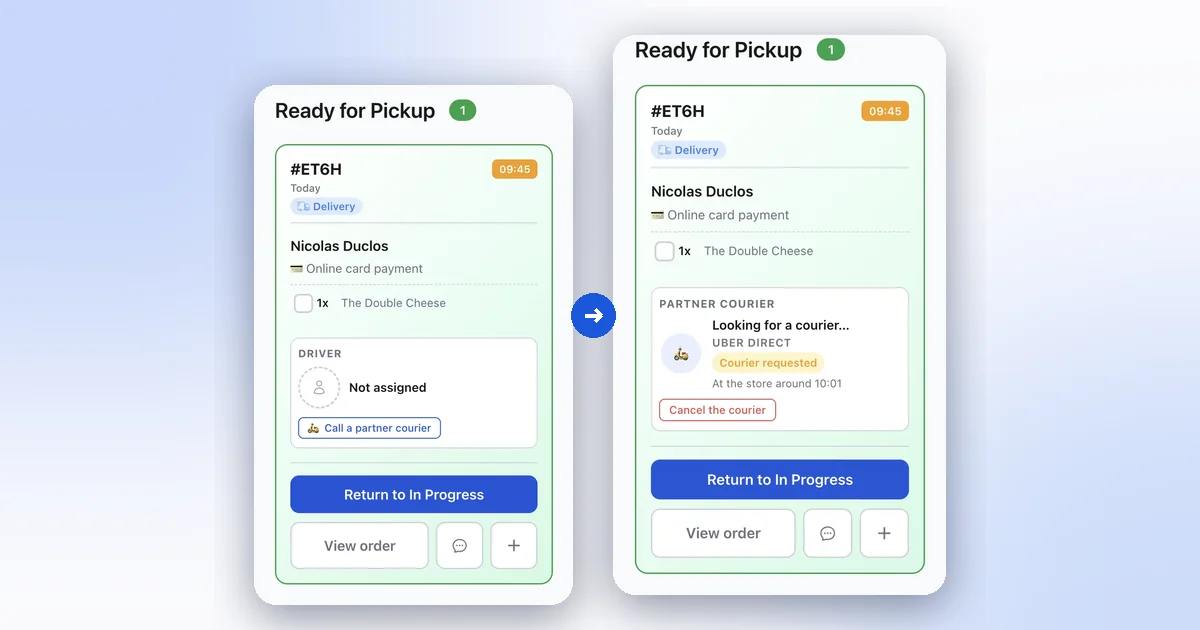
You do collection, demand for delivery is there, but you have nobody to deliver. Or you have two drivers and on Friday night they are swamped from 7:30pm. For a long time the only answer was binary: hire and manage a fleet, or hand your sales to a platform that takes 25 to 35% of the ticket. There is a third way, still little known among independent restaurants: restaurant delivery without drivers, using on-demand couriers booked per trip. Uber Direct, DoorDash Drive and Stuart offer exactly that. Here is how it works, what it really costs, and how to set it up without changing the way you work.
On-demand couriers and delivery platforms are not the same business
The confusion is common, because the same groups do both. A delivery platform is a marketplace: it lists your menu next to a hundred others, takes the order, charges the customer and pays you the amount minus its commission. You rent an audience, and you pay that rent on every sale. We broke down the full mechanics in our article on the real cost of delivery platforms.
An on-demand courier service does the opposite. It sells nothing and does not list your menu. It makes its courier network available, booked trip by trip, to deliver an order the customer placed with you: on your website, in your app, over the phone. The provider bills the trip, and only the trip. The customer, their details, their order history and the margin stay with you.
| Delivery platform | On-demand courier | |
|---|---|---|
| Who takes the order | The platform, on its marketplace | You, on your website or app |
| Who charges the customer | The platform | You |
| What you pay | A 25 to 35% commission on the ticket | The trip price, per delivery |
| Who owns the customer | The platform | You |
| Visibility | One listing among hundreds | None: you bring your own customers |
| Delivery | The platform’s couriers | The same couriers, booked for you |
The last line deserves emphasis: on the street, these are often the same couriers. The difference is not in the delivery, it is in who owns the commercial relationship.
How an order unfolds, minute by minute
Take a pizzeria with no drivers that has connected Uber Direct to its ordering app. A customer orders two pizzas for delivery from the app at 7:42pm and pays by card. The order lands on the restaurant’s order screen like any other.
The pizzaiolo starts preparation. At that moment, a courier request goes out automatically to Uber Direct, with the restaurant address, the customer address and the time the order will be ready. A few minutes later a courier accepts the trip: their first name, their stage (heading to the restaurant, arrived, delivering) and their estimated arrival time appear on the order.
The courier picks up the pizzas at the counter, possibly by giving a pickup code. On the customer side, the restaurant’s app shows a map with the courier moving in real time, exactly as if it were an in-house driver. At 8:08pm the courier confirms the delivery, and the order switches to “delivered” on its own on the restaurant screen. Nobody phoned anybody.
What it really costs
This is the first question that comes up, and the answer has three parts.
The trip price. It is set by the provider, not by your software, and depends on the city, the distance and the time of day. It varies from one urban area to the next and from one country to the next, which is why a single figure would not be honest here. What matters is that you know it before committing: as soon as your account is connected, you see the price of a typical trip from your store, and every quote is displayed before booking.
What your customer pays. You set your delivery fee as you do today. Two approaches work: a flat fee, easy to read and reassuring, or the trip price plus a margin, fixed or as a percentage. If your fee is higher than the trip price, you keep the difference. If it is lower, you cover it, exactly as you would with a salaried driver on a quiet evening.
What the middleman takes. Nothing on your sales. The provider bills the trip to the account you opened with them. The software that runs all this should not take a cut either: at XPRIO, partner couriers are included in the subscription, with no commission and no surcharge.
Run the numbers with your own figures. On a £30 delivered ticket, a 30% commission is £9. A courier trip in a mid-sized city, over a 1 to 2 mile radius, usually costs noticeably less, and above all that amount is largely covered by the delivery fee the customer already pays. To compare with an in-house fleet, our guide on in-house fleet versus platform gives the break-even point for a salaried driver: below two deliveries per hour, they cost more than a courier per trip.
Test it with your own menu, no commitment
10-day free trial, no card needed. Connect an Uber Direct or Stuart test account and check coverage for your address within the hour.
Two ways to work: courier only, or as backup for your drivers
Not every restaurant has the same need, and a good tool should allow both modes, store by store.
Partner courier only. You have no drivers. Every delivery order automatically triggers a booking when preparation starts. You touch nothing at the counter. This is the natural mode for a fast-food place that only did collection, a dark kitchen, or a business that wants to open delivery without hiring.
My drivers, plus a courier as backup. Your drivers come first. On a ready order nobody has taken, a “Call a partner courier” button appears on the order. You can also make this fallback automatic: if no driver has assigned themselves 5, 10 or 30 minutes after “ready”, the courier is requested by itself. This is the mode for Friday nights, rainy days and weeks when a driver is off.
| Your situation | Recommended mode | Customer fee |
|---|---|---|
| No drivers, you want to open delivery | Courier only | Flat fee or quote + margin |
| A small team, swamped at peak times | Backup, automatic fallback after 10 to 15 min | Your usual fee |
| Several stores with different profiles | One mode per store | Set per store |
| You already deliver with Uber Direct or Stuart | Courier only, same account | Unchanged |
Which provider for your country
The three networks do not cover the same territories, and the right software only offers those available in your store’s country.
- Uber Direct is the widest: United Kingdom, Ireland, France, Spain, Portugal, Germany, Italy, Belgium, Netherlands, Switzerland, Sweden, Poland, United States, Canada, Mexico, Brazil, Chile, Costa Rica, Australia, New Zealand, Japan, Taiwan and South Africa. The test account is instant, the live account is approved within a few days.
- Stuart covers the United Kingdom, France and Poland, with bike and scooter couriers in major cities. Instant test account, live account after a conversation with their sales team.
- DoorDash Drive covers the United States, Canada, Australia and New Zealand. Instant test account, but live access is subject to a quarterly review by DoorDash, which can take several weeks and is not guaranteed.
In every case, real coverage is decided at city level: major urban areas and their close suburbs. Do not start from a national coverage map, start from your address. A test account lets you check it before activating anything, and every customer address should then be checked at checkout, so the customer knows before paying whether their street is served.
The limits to know before you start
On-demand delivery is not magic, and it is better to know its constraints than to discover them on a Saturday night.
Online payment is required. A partner courier does not collect money: no cash, no cheque, no card on delivery. Orders delivered by courier are therefore paid by card in your app or on your website. If part of your clientele pays cash, they keep doing so for collection, dine-in and deliveries by your own drivers.
Availability at peak times depends on the provider. On a rainy Saturday at 8pm there may be more requests than couriers. Your tool must alert you immediately if no courier is found, so you can request again, hand the trip to an in-house driver, or warn the customer from the order’s messaging.
A late cancellation may be charged. You can cancel a courier as long as the order has not been picked up, but the provider may charge a fee if the courier was already on their way. So book at the right moment: when preparation starts, not when the order comes in.
Proof of delivery varies. Uber Direct supports a code the customer gives the courier. DoorDash Drive and Stuart use a photo or a signature. Nothing to do on your side, but worth knowing when a customer asks.
Setup: three steps, about an hour
The longest part is administrative, not technical.
- Open the account with the provider. It is free, in your name, with a card on file to pay for trips. You collect two or three access keys from their developer area. A test account is available right away to run trials without a real courier.
- Paste the keys into your ordering software. In XPRIO, this happens under App Configuration, Partner couriers. As soon as it is connected, the screen shows the price of a typical trip from your store and confirms your address is covered.
- Choose the mode for each store. In the store’s settings, Delivery and services tab: courier only, or your drivers with a courier as backup, with the automatic fallback delay if you want one. Online payment must be enabled, otherwise the courier modes stay greyed out.
From then on, everything happens on the order screen you already use. The courier appears on the order, the customer tracks them in the app, and the order closes itself.
What it changes for an independent
The real gain is not just the commission saved. It is being able to say yes to delivery without hiring, without managing driver rotas, and without handing your customers to a marketplace that will resell them to the competitor across the street. Your branded app takes the order, the courier delivers, and every delivered customer stays in your database for your next notifications and your loyalty programme.
To see the actual screens, the providers available in your country and answers to the most common questions, visit our dedicated page on delivery without drivers. And if you do have drivers, this is not a choice against them: it is a spare wheel that only kicks in when they are all out.
Get hands-on with XPRIO
Mobile app, website, order management: all live in 72 hours. No commitment.
Start my free trialFrequently asked questions
Can I offer delivery without having any drivers?
Yes. On-demand courier services such as Uber Direct, DoorDash Drive or Stuart deliver your orders per trip, with no marketplace and no commission on your sales. Your customer orders on your own website or app, the courier only delivers.
What is the difference between Uber Direct and a delivery platform?
A platform sells your dishes on its marketplace and takes a commission on every sale. Uber Direct sells nothing: it is a courier network you book per trip, for orders placed with you. You keep the customer, their data and the margin.
How much does an on-demand courier trip cost?
The price is set by the provider based on city, distance and time of day. You see it before each trip, and your customer pays the delivery fee you decide: a flat fee, or the trip price plus a margin.
Can the customer pay cash on delivery?
No. A partner courier does not collect money, so the order must be paid online. Cash remains possible for collection, dine-in and deliveries made by your own drivers.
Is my city covered by Uber Direct, DoorDash Drive or Stuart?
All three networks cover major cities and their suburbs. The simplest check is to open a free test account, available immediately, and confirm your store address is served before activating anything.
Can I keep my drivers and only call a courier when needed?
Yes, that is backup mode: your drivers come first, and a courier is only called when they are all out, either manually or automatically after a delay you choose.
Get hands-on with XPRIO
Mobile app, website, order management: all live in 72 hours. No commitment.
Start my free trialRelated articles
Click & Collect, Delivery, or Pickup: Which Channel Should Your Restaurant Choose in 2026?
Click and collect, delivery, or takeout: a complete comparison of costs, margins, and strategy to pick the right channel for your restaurant in 2026.
How Much Do Delivery Platforms Really Cost a Restaurant Owner in 2026?
Delivery platform commission, hidden fees, margin impact: a full breakdown of the real costs and viable alternatives in 2026.
Take Back Control: The Practical Playbook to Gradually Leave Third-Party Delivery Platforms
Leave delivery platforms with no risk: a 6-month switch plan, concrete weekly steps, and measured margin recovered for restaurant operators.