How Much Does a Restaurant App Cost in 2026? Prices, Hidden Costs and Alternatives
What a restaurant app really costs in 2026: custom development, no-code builders or a white-label subscription. Realistic ranges, hidden costs and how to compare them with delivery app commission.
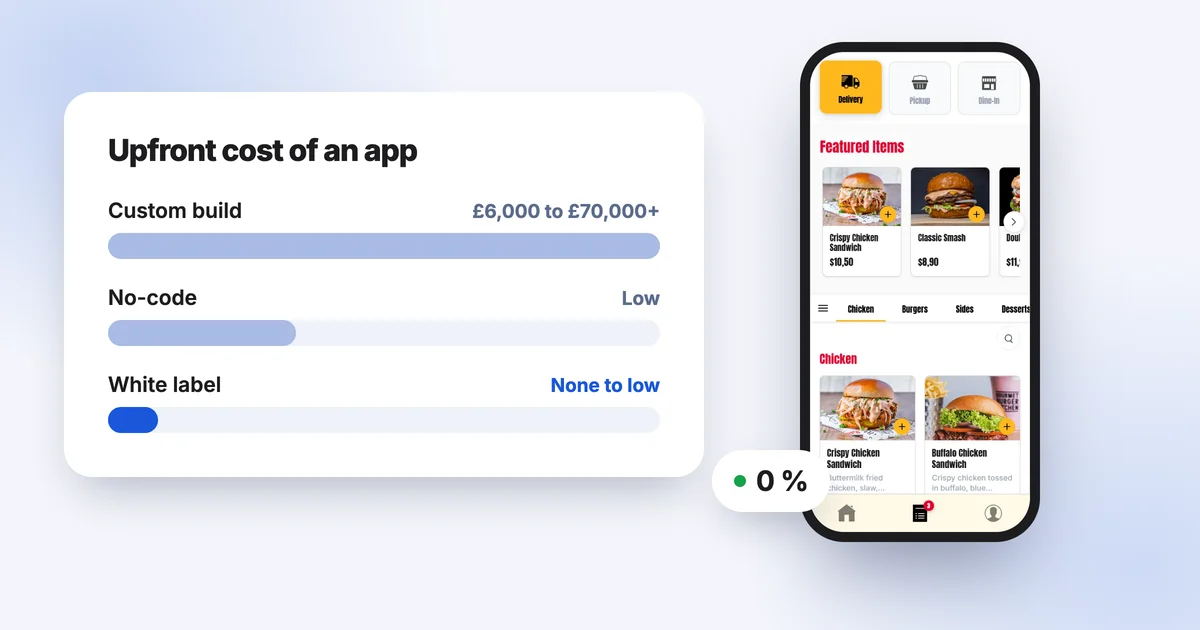
“How much does an app for my restaurant cost?” It is usually the first question operators ask once they are tired of handing a slice of every order to the delivery apps. It is also the question with the vaguest answers online: “anywhere from £5,000 to £500,000”, “it depends”… Not much help when you need to make a decision.
This guide gives you an honest picture. There are three ways to get an ordering app for your restaurant or takeaway: have it custom built, build it yourself with a no-code tool, or rent a ready-made white-label app. Each one has a very different upfront price, running costs and hidden costs. We go through them one by one, then show you how to compare those figures with what commission is costing you today.
What a restaurant app actually needs to do
Before talking about price, you need to know what you are buying. An ordering app for an independent restaurant is not just a shop window with your menu. To be useful every day, it should at least:
- show your menu with photos, options, extras and meal deals;
- handle several ways to order: collection, delivery and dine-in;
- take card payments online, including Apple Pay and Google Pay, and ideally cash too;
- send orders to your team in real time, with a sound alert;
- keep customers updated at every step with push notifications;
- bring customers back with points, rewards and promo codes;
- work on iPhone, Android and a website for people who will not download anything.
Every one of those building blocks costs money to develop. That is why quotes vary so much: an “app” at £3,000 and another at £50,000 simply do not do the same job.
Option 1: custom development (agency or freelancer)
This is the traditional route: you write a brief, an agency or freelance developer designs the app, builds it and publishes it.
Typical price ranges
Rates vary hugely depending on location, experience and scope. The figures below are indicative ranges seen in the UK market and are no substitute for a proper quote:
- Freelancer, simple app (menu, basket, payment, one platform or a cross-platform framework): often between £6,000 and £20,000.
- Agency, full ordering app (iOS, Android, admin panel, payments, notifications, loyalty): commonly between £20,000 and £70,000, sometimes more.
- Advanced project (multiple sites, driver app, kitchen display, integrations): budgets easily go beyond £90,000.
On top of that comes the build time: three to six months between the first meeting and going live is common.
The upside
You get exactly what you asked for, and you own the code if the contract says so. For a large brand with very specific needs, it is often the only serious option.
The catch for an independent restaurant
The bill does not stop at launch. An app needs maintaining: Apple and Google release new versions of their systems every year and regularly require technical updates. A common rule of thumb is 15 to 20% of the initial cost per year for maintenance. On a £35,000 project, that is £5,000 to £7,000 a year before a single new feature is added.
Option 2: no-code app builders
No-code builders promise you can create your own app with drag and drop, for a monthly plan. Depending on the tool and the tier, plans range from a few tens to over a hundred pounds a month.
On paper it is the cheapest option. In practice, three things push the cost up:
- Your time. Building an ordering app that really works (options, payments, order statuses, notifications) takes dozens of hours. That is time you are not spending in the kitchen or front of house.
- Paid add-ons. Payments, push notifications, loyalty or app store publishing are often reserved for higher tiers or sold as extras.
- Publishing. In most cases it is up to you to create the developer accounts, prepare the App Store and Google Play listings and get through Apple’s review, which regularly rejects apps that are little more than a website.
No-code works well for testing an idea or building an information app. For a real ordering channel, with money changing hands every evening, it is a bigger gamble.
Option 3: a white-label app on a subscription
White label means an app that has already been built and that the provider customises with your name, logo, colours and menu, then publishes on the App Store and Google Play. Your customers download “your” app; they never see the provider.
You do not pay for development, but a monthly subscription that covers the app, hosting, maintenance and updates. Depending on the offer, prices range from a few tens to a few hundred pounds a month.
One thing to watch: some offers add commission on every order, a setup fee or a 12- or 24-month contract. Before signing, ask three simple questions:
- Is there any commission or per-order fee?
- Are there setup or cancellation fees?
- Are app store publishing and updates included?
Your own branded app, with no development bill
iOS and Android app, ordering website, table ordering and loyalty. 0% commission, 10-day free trial with no card required.
The hidden costs people forget
Whichever route you choose, some costs always come back. Best to have them in mind before you compare quotes.
Apple and Google developer accounts
If the app is published under your own account, Apple charges US$99 a year for the Apple Developer Program (billed in local currency), and Google charges a one-off US$25 to open a Google Play Console account. The amounts are small, the paperwork less so: to publish under your company name with Apple you need an organisation account, which among other things requires a D-U-N-S number.
Hosting and servers
An ordering app needs a server to receive orders, store your menu and send notifications. With a custom build, hosting, the SSL certificate, backups and monitoring are billed separately, every month.
Maintenance and updates
A new version of iOS, new Google Play rules, a security flaw in a library: an app that is not kept up to date eventually stops working or gets removed from the stores.
Payment fees
Taking card payments online always costs something, whatever the tool. With Stripe, for example, the standard rate for UK cards is around 1.5% plus 20p per transaction (check the provider’s current pricing). You pay these fees at the till too: they are not specific to having an app.
Your time
This is the cost people forget most often. Following a build, testing each version, dealing with app store rejections or wrestling with a no-code tool all take hours away from running the restaurant.
Comparison table: the three routes side by side
| Custom build (agency, freelancer) | No-code | White label | |
|---|---|---|---|
| Upfront cost | Roughly £6,000 to £70,000 and up | Low | None to low |
| Monthly cost | Hosting + maintenance | Plan + add-ons | Fixed subscription |
| Time to launch | Several months | Weeks of your own time | A few days |
| App store publishing | The developer or you | Usually you | Usually the provider |
| Updates | Billed | Your job | Included |
| Best for | Brands with very specific needs | Simple projects, testing an idea | Independent restaurants and small groups |
The figures are orders of magnitude. What matters is the total cost over three years, not just the upfront price.
How to compare it with delivery app commission
You cannot judge a restaurant app on its price alone: you have to compare it with what it saves you. On delivery apps, commission typically sits between 25 and 35% of the order value, depending on the contract and the options you choose.
Here is the maths with 30% commission:
- Write down the monthly value of orders coming through the delivery apps. Example: £3,000.
- Work out the commission paid: £3,000 × 30% = £900 a month.
- Estimate the share of regulars who could order directly from you. Even with a cautious 20%, that is £600 of orders and £180 of commission saved every month.
- Compare that with the monthly cost of your app.
Another way to look at it: at 30% commission, a £109 subscription pays for itself once roughly £365 of monthly orders go through your own channel instead of a platform. That is around twenty £18 orders a month.
Delivery apps are still useful for getting discovered. The goal is not necessarily to leave them overnight, but to have your regulars order from you, commission-free.
Keep the apps to get discovered: XPRIO is there so your regulars order from you directly, commission-free.
What you keep on top every year
$3,204
Commission saved every month
$396
XPRIO subscription per month (excl. VAT)
$129
Indicative estimate, excluding bank fees for online payment on your XPRIO app.
Where XPRIO fits in
XPRIO is a white-label solution built for independent restaurants and takeaways. The pricing is simple: £109 a month in the UK, all-inclusive, with no commission on your sales, no setup fee and no contract. The 6-month and annual plans come with 5% and 10% off respectively.
The subscription includes:
- an iOS and Android app under your name, with your logo, colours and menu;
- an online ordering website, hosted with OVHcloud, SSL certificate included;
- QR code table ordering, with no account needed for the customer;
- loyalty, referrals, promo codes and promotions;
- push notifications included;
- a kitchen display and real-time order tracking on a phone or tablet;
- publishing on the App Store and Google Play, handled by our team.
As for timing, the ordering website works the same day and the apps are published on the stores within a few days of subscribing. Don’t want to type in your menu? Send it as a PDF or a photo: our team will set it up for you within 1 business day. Support is available 7 days a week.
Online payments go through your own Stripe account: the money lands directly with you, and XPRIO takes nothing from transactions. You can also accept cash or payment on delivery.
To see what the app looks like, head to our restaurant app page, and for plan details, see our pricing. If all you need for now is a printable menu, our free menu maker can help too.
Questions to ask before you choose
Before you sign anything, here is a quick checklist:
- What is the total cost over three years, including maintenance and hosting?
- Is there any commission per order, however small?
- Who publishes the app on the App Store and Google Play, and under whose name?
- Are the updates required by Apple and Google included?
- Does money from online payments go straight into your account?
- Can you try the tool for free before committing?
- Is there a minimum term or a cancellation fee?
If you get clear answers to these seven questions, you will know exactly what you are paying for.
Try XPRIO free for 10 days
iOS and Android app, ordering website, table ordering and loyalty for £109 a month. No commission, no contract, no card needed for the trial.
Start my free trialKey takeaways
- A custom-built restaurant app usually costs tens of thousands of pounds, plus 15 to 20% a year in maintenance.
- No-code looks cheap, but your time, paid add-ons and app store publishing add up.
- A white-label subscription is the best fit for most independent restaurants, as long as you check there is no commission and no lock-in.
- Always compare the cost of the app with the commission you pay today: that is where its return is decided.
In 2026, having your own app is no longer reserved for the big chains. The real question is no longer “how much does it cost?” but “how much is not having one costing me?”.
Frequently asked questions
How much does a restaurant app cost in the UK?
It depends on the route. A custom build usually runs into tens of thousands of pounds, a no-code builder costs a monthly plan plus a lot of your time, and a white-label app is rented monthly, for example £109 a month all-inclusive with XPRIO.
How much does it cost to put an app on the App Store and Google Play?
If you publish yourself, Apple charges US$99 a year for its Developer Program and Google charges a one-off US$25 fee. With a white-label solution, publishing is usually handled by the provider.
Can I get a cheap app for my restaurant?
Yes, by avoiding custom development. A white-label subscription gives you an iOS and Android app under your own name for a fixed monthly cost, with no development or maintenance bills to plan for.
What are the hidden costs of a mobile app?
Developer accounts, hosting, maintenance and the updates Apple and Google require, card payment fees and the time spent managing it all. On a custom build, maintenance is often 15 to 20% of the initial cost every year.
Is a restaurant app worth it compared with delivery app commission?
With delivery app commission typically between 25 and 35%, moving a few hundred pounds of orders a month to your own app is enough to cover a fixed subscription.
How long does it take to launch a restaurant app?
Several months for a custom build, a few days for a ready-made solution. With XPRIO, the ordering website works the same day and the apps are published on the stores within a few days.
Get hands-on with XPRIO
Ordering website the same day, mobile app within a week, order management included. No commitment.
Try free for 10 daysRelated articles
How to Create a Free QR Code Menu for Your Restaurant (2026 Guide)
Free QR code menu for restaurants: the step-by-step method with a PDF and a free generator, its limits, then QR code table ordering with XPRIO.
How to Increase Pizza Sales: 10 Practical Ways to Grow Your Pizza Shop
Average order value, loyalty cards, quiet nights, commission-free online ordering, click and collect, Google reviews, Instagram and lunch deals: 10 practical ways to grow your pizza takeaway.
How to Launch Your Restaurant Ordering App in a Week: The Complete 2026 Guide
Launch a restaurant app in a week instead of 6 months: the complete 2026 guide to ship your website, iOS and Android apps with no developer and no insane budget.